Announcing that the great day of the lord is nearer than you think. O Come let us adore him - Luke 2:13
Passover Chart Guide
Understanding the timeline data step by step
Passover Times
This chart walks you through key events in order, making complex data easy to follow and learn.
Easy
Clear


The interpretation of Scripture must rest on the calendar that Scripture itself establishes. The Torah defines time by the new moon, the counting of days from evening to evening, and the sequence of appointed times anchored in Nisan, not by later systems shaped by myth, custom, or inherited tradition. When biblical events are placed into foreign calendars, the narrative is distorted: dates shift, prophetic patterns blur, and the rhythm of redemption, instruction, rest, and renewal becomes unrecognizable. To understand this clearly, we must speak in a way that reaches every kind of learner, those who think in images and story, those who reason through data, those who want practical clarity, and those who learn by testing and discovery.
The biblical calendar restores the story of redemption to its original rhythm. It lets us see the Exodus, the ministry of Yeshua, and the Apostolic witness inside the same cycle of new moons, Sabbaths, and appointed times that shaped their world. When we return to this rhythm, the narrative becomes coherent again: the Lamb given on Nisan 14, rest on Nisan 15, life emerging on Nisan 17, and the dawn of discovery on Nisan 18. The story only makes sense inside the calendar God gave.
The data confirms the narrative. Based solely on the chronological information in this document:
Nisan 14 is the day of crucifixion.
Nisan 17 is the completion of the three‑day period and is consistently not Sunday.
Nisan 18 is the first day of the week and the moment of discovery.
Your tables preserve all three Gospel timestamps without contradiction. The Greek text supports this:
“τη δε μια των σαββατων όρθρου βαθεος ήλθον επι” (Luke 24:1)
This describes the arrival of the women on the first day of the week, not the resurrection moment itself.
Across all years in your tables (3785–3796):
Nisan 17 = Monday, Tuesday, Thursday, or Shabbat
Never Yom R’Shon (First Day of the Week)
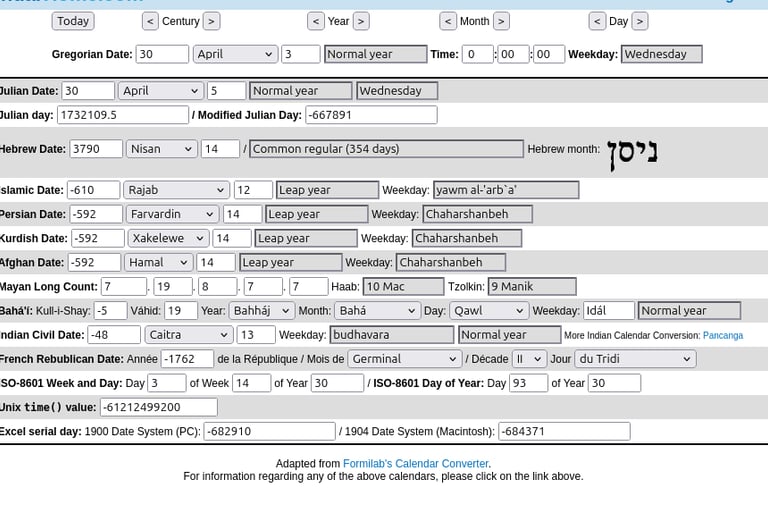
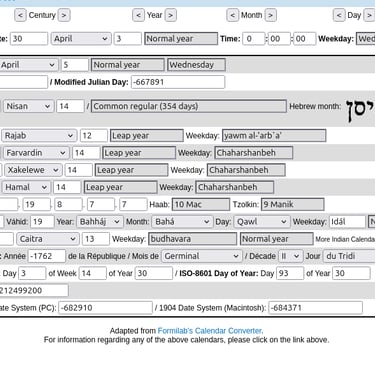
This is reinforced by the U.S. Naval Observatory sunset data: “3790 … Nisan 14 … Yom Rvi’ee … 5:58pm”
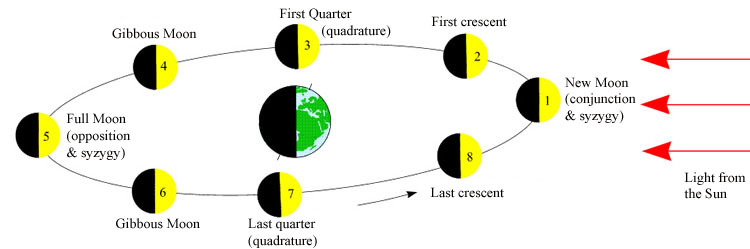
…and by the Hebcal and CalendarHome conversions. The analytical structure is airtight. Because the Biblical month begins with the new moon, NASA’s reconstructed lunar data allows us to determine Nisan 1, Nisan 14, and Nisan 17 for every ancient year. In every plausible crucifixion year (28–33 CE), Nisan 17, the day of Firstfruits and the completion of ‘three days and three nights’- never falls on a Sunday. The Gospels never say Yeshua rose on Sunday; they say He was found risen on Sunday. Therefore, the Sunday‑resurrection tradition is not supported by Scripture, the Biblical calendar, or the astronomical record. The heavens and the Torah agree: the resurrection completes at the close of Shabbat, on Nisan 17, the Feast of Firstfruits.
If you use the wrong calendar, you get the wrong dates. If you get the wrong dates, you misunderstand the events.
Foreign calendars were never designed to preserve:
Passover
Unleavened Bread
Firstfruits
Shavuot
The High Sabbath
The weekly Sabbath cycle
The biblical calendar is the only system that keeps the events of Yeshua’s final week in their proper order. It is the only system that preserves the meaning the authors assumed. It is the only system that makes the Gospel accounts line up without forcing contradictions. Nicaea did not create a liturgical year, but by severing Easter from Passover it severed the Church from the biblical calendar itself. Once the council rejected the timing God established in Torah, the Western Church was forced to invent an entirely new liturgical structure to replace the one it had abandoned. That structure rested on an anti‑Jewish foundation that later theologians rarely acknowledged and often deliberately obscured. Compounding the confusion, the Church took the word Pascha, which had always meant Passover, and reassigned it to the Sunday after Passover. This linguistic shift was not only historically incoherent; it was theologically reckless. Redefining a biblical term to fit a post‑biblical tradition is not interpretation but invention. The deeper issue is the assumption that the Church possessed the authority to make such determinations in the first place. Nothing in Scripture grants the Church the right to redefine God’s appointed times or to replace the biblical calendar with a human one. If the biblical authors could time‑travel and hear that Pascha now meant “the Sunday after Passover,” they would probably look around the room, check the calendar, and ask, “Who changed the definitions while we were gone, and why is everyone pretending this makes sense?” What happened at Nicaea is like taking the blueprint for a house, ignoring the measurements, and then blaming the original architect when the roof doesn’t fit. The Church set aside the calendar God designed, built a new structure on different measurements, and then insisted the original plans were the problem. It’s no wonder the pieces stopped lining up, the builders swapped out the ruler and kept insisting the house was still the same.
Quick FAQs
What the Church did?
Constantine, Irenaeus, and Anatolius all contributed to the same fundamental error that culminated at Nicaea: they treated the biblical calendar as a Jewish ethnic calculation rather than a divine decree. By reframing the 14th of Nisan as a “Jewish practice” instead of God’s appointed time, they created the theological justification for severing Easter from Passover. This shift allowed the Church to redefine Pascha, abandon the biblical calendar, and construct a new liturgical system on its own authority. Their mischaracterization of God’s calendar as merely “Jewish” laid the groundwork for the anti‑Jewish posture that shaped the Council’s decisions and the Western liturgical year that followed.
The Quartodeciman controversy - Really?
Calling it the “Quartodeciman controversy” is almost comical, because the issue was never about 'Jewish' calculations in the first place. God Himself set the 14th of Nisan as the date of Passover. No Jewish think tank, no commitee was formed to invented it, and no church council has the authority to move it. The timing of Yeshua’s crucifixion is anchored in God’s own calendar, not in human tradition. Treating a divine appointment as if it were a negotiable Jewish custom is precisely how the Church ended up rewriting the calendar and then pretending the revision was theological progress.
The unavoidable theological reality:
To take a divine appointment, a time God Himself established, and replace it with a human alternative is not merely an error of tradition. It is a form of presumption that borders on blasphemy, because it treats God’s decree as something humans may override. When the Church acted as though it could relocate the timing of Passover and the crucifixion, it behaved as if its authority stood above the command of God. That posture was dangerous then, and it remains dangerous now. This is the same kind of error the rabbis committed with the Mesorah, elevating human tradition to the point where it functionally overrode the plain command of Scripture. When the Church replaced God’s calendar with its own, it repeated the very pattern it later accused Judaism of committing. Both systems ended up treating divine decree as if it were negotiable, adjustable, or subordinate to institutional preference.
Faith
Nature
contact@tishrei15.com
© 2025. All rights reserved.